

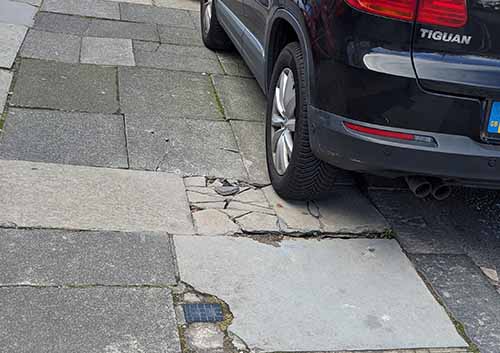
In January 2026 the Government announced the results of the consultation on pavement parking that took place towards the end of 2020. Anybody who has even a passing interest in being able to get around their local area will be familiar with the word ‘consultation’ becoming a synonym of ‘a very long wait’, but at SPACE for Heaton we used the years between the consultation and the outcome being announced to carry out an extensive, year long assessment of the effect of pavement parking on pavements, focusing on just one paving slab on Rothbury Terrace, close to the junction with Chillingham Road.
With local elections looming, and now councils can get the power to do something to prevent pavement parking, we are sharing our findings.
In summary, cars destroy pavements.
Read on the see how we discovered this.
December 2023
During the year we spent documenting one paving slab, as our subject slab was slowly turned from an intact, rectangular chunk of stone into pile of rubble, we photographed its plight and, in doing so, ended up with a record of how often a space that should be safe and easy for people to walk on was, and still is, anything but.
We started our documentation in December 2023. At this point the pavement was looking a bit uneven. It had vehicles parked on it but our chosen paving slab, identified with a red arrow, was intact if not quite level.

March 2024
We next checked in with the paving slab a couple of months later in March 2024. By then the slab had started to suffer under the forces regularly applied to it by drivers illegally driving on the pavement. One corner had broken off and it had lost its stable foundation. On the rare occasion there wasn’t a car on top of it, it was just waiting for a pedestrian to step on it in wet weather before tilting and covering their feet in cold water.

July 2024
In July 2024 it looked like our subject slab may see salvation as the surrounding pavement was marked up for repair. In a very rare occurrence, somebody had parked a car entirely on the road, almost as if they were aware the makings were highlighting damage caused by drivers.

Sadly, this brief moment of optimism didn’t last. The repair markings were worn away by the weather, and the one driver who parked correctly on the road was seen off by people with larger, heavier vehicles who upped their campaign of illegal driving on the pavement.
October 2024
By October 2024 our subject slab was in a very sorry state. Half of it was in small pieces and the other half lay terminally cracked beneath the wheels of a large heavy automobile.

November 2024
Throughout November, drivers continued their illegal driving on the pavement, with the surrounding paving slabs starting to suffer too. People in electric cars got involved to highlight that just because a vehicle has a zero emission form of propulsion doesn’t mean it causes any less damage to the fabric of the city.

December 2024
By December, one year into our study, it looked like the surface was so bad that even drivers were avoiding it, though they still liked to get their vehicles on the kerb so that could be damaged too.

January 2025
The dawn of 2025 saw renewed enthusiasm for illegal driving and an apparent desire to pulverise the subject paving slab in to as many pieces as possible.

Then, towards the end of January 2025, 6 months after repair markings had originally appeared on the pavement there was a big development – cones appeared!
That didn’t stop people parking on the pavement of course, but was a hint that maybe something would soon be improving.

Within a week a full set of barriers appeared, the broken paving was removed and shortly afterwards concrete was poured to fill the gaps where paving slabs once lay.
In retrospect, the choice of materials – concrete instead of paving – was an early indication of what was going to be done to address the cause of the damage.
Absolutely nothing.
Within days of the barriers being removed fresh tyre marks provided clear evidence that illegal driving was continuing, the pavement still wasn’t safe to walk on, and that before long it would be as damaged as it was before the repair.

Our study ended as it had begun. The pavement blocked by vehicles. The only difference being the surface had been made stronger to accommodate vehicles while the needs of pedestrians are ignored altogether in this location. The remaining paving slabs are starting to suffer the same fate as the subject of our study. The surface is once again difficult to walk on if you are lucky enough to be passing on a day when there is some pavement that isn’t beneath a vehicle.

Epilogue – April 2026
A little over a year since the replacement of the slab in our study the new concrete is starting to crack (and is beneath a large car parked on the pavement).

Nothing has been done to address the cause of the damage, or the obstruction of the pavement. More money will shortly need to be spent to make the pavement safe again, which will be wasted unless the underling cause of the damage – cars being driven on the pavement – is stopped.
Take Action
At the time of writing we a weeks away from elections in Newcastle. When you speak to candidates that are looking for your vote ask them if they will take advantage of the powers Government want to delegate to make pavements safe for people, save money, and stop drivers behaving dangerously in Heaton.